penenrapan situs kamus online - ujian praktek


Galaxy

From Wikipedia, the free encyclopedia
Jump to navigationJump to search
NGC 4414, a typical spiral galaxy in the constellation Coma Berenices, is about 55,000 light-years in diameter and approximately 60 million light-years from Earth.

galaxy is a gravitationally bound system of starsstellar remnantsinterstellar gasdust, and dark matter.[1][2] The word is derived from the Greek galaxias (γαλαξίας), literally 'milky', a reference to the Milky Way galaxy that contains the Solar System. Galaxies range in size from dwarfs with just a few hundred million (108) stars to giants with one hundred trillion (1014) stars,[3] each orbiting its galaxy's center of mass.

Galaxies are categorized according to their visual morphology as elliptical,[4] spiral, or irregular.[5] Many are thought to have supermassive black holes at their centers. The Milky Way's central black hole, known as Sagittarius A*, has a mass four million times greater than the Sun.[6] As of March 2016, GN-z11 is the oldest and most distant galaxy observed. It has a comoving distance of 32 billion light-years from Earth, and is seen as it existed just 400 million years after the Big Bang.

In 2021, data from NASA's New Horizons space probe was used to revise the previous estimate to roughly 200 billion galaxies (2×10¹¹),[7] which followed a 2016 estimate that there were two trillion (2×10¹²) or more[8][9] galaxies in the observable universe, overall, and as many as an estimated 1×1024 stars[10][11] (more stars than all the grains of sand on all beaches of the planet Earth).[12] Most of the galaxies are 1,000 to 100,000 parsecs in diameter (approximately 3,000 to 300,000 light years) and are separated by distances on the order of millions of parsecs (or megaparsecs). For comparison, the Milky Way has a diameter of at least 30,000 parsecs (100,000 ly) and is separated from the Andromeda Galaxy, its nearest large neighbor, by 780,000 parsecs (2.5 million ly.)

The space between galaxies is filled with a tenuous gas (the intergalactic medium) with an average density of less than one atom per cubic meter. Most galaxies are gravitationally organized into groupsclusters and superclusters. The Milky Way is part of the Local Group, which it dominates along with Andromeda Galaxy. The group is part of the Virgo Supercluster. At the largest scale, these associations are generally arranged into sheets and filaments surrounded by immense voids.[13] Both the Local Group and the Virgo Supercluster are contained in a much larger cosmic structure named Laniakea.[14]


Etymology[edit]

The word galaxy was borrowed via French and Medieval Latin from the Greek term for the Milky Way, galaxías (kúklos) γαλαξίας (κύκλος)[15][16] 'milky (circle)', named after its appearance as a milky band of light in the sky. In Greek mythologyZeus places his son born by a mortal woman, the infant Heracles, on Hera's breast while she is asleep so the baby will drink her divine milk and thus become immortal. Hera wakes up while breastfeeding and then realizes she is nursing an unknown baby: she pushes the baby away, some of her milk spills, and it produces the band of light known as the Milky Way.[17][18]

In the astronomical literature, the capitalized word "Galaxy" is often used to refer to our galaxy, the Milky Way, to distinguish it from the other galaxies in our universe. The English term Milky Way can be traced back to a story by Chaucer c. 1380:

See yonder, lo, the Galaxyë
 Which men clepeth the Milky Wey,
 For hit is whyt.

— Geoffrey Chaucer, The House of Fame[16]

Galaxies were initially discovered telescopically and were known as spiral nebulae. Most 18th to 19th century astronomers considered them as either unresolved star clusters or anagalactic nebulae, and were just thought of as a part of the Milky Way, but their true composition and natures remained a mystery. Observations using larger telescopes of a few nearby bright galaxies, like the Andromeda Galaxy, began resolving them into huge conglomerations of stars, but based simply on the apparent faintness and sheer population of stars, the true distances of these objects placed them well beyond the Milky Way. For this reason they were popularly called island universes, but this term quickly fell into disuse, as the word universe implied the entirety of existence. Instead, they became known simply as galaxies.[19]

Nomenclature[edit]
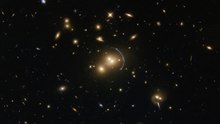
Galaxy cluster SDSS J1152+3313. SDSS stands for Sloan Digital Sky Survey, J for Julian epoch, and 1152+3313 for right ascension and declination respectively.

Tens of thousands of galaxies have been catalogued, but only a few have well-established names, such as the Andromeda Galaxy, the Magellanic Clouds, the Whirlpool Galaxy, and the Sombrero Galaxy. Astronomers work with numbers from certain catalogues, such as the Messier catalogue, the NGC (New General Catalogue), the IC (Index Catalogue), the CGCG (Catalogue of Galaxies and of Clusters of Galaxies), the MCG (Morphological Catalogue of Galaxies), the UGC (Uppsala General Catalogue of Galaxies), and the PGC (Catalogue of Principal Galaxies, also known as LEDA). All the well-known galaxies appear in one or more of these catalogs but each time under a different number. For example, Messier 109 (or "M109") is a spiral galaxy having the number 109 in the catalog of Messier. It also has the designations NGC 3992, UGC 6937, CGCG 269-023, MCG +09-20-044, and PGC 37617 (or LEDA 37617). Millions of fainter galaxies are known by their identifiers in sky surveys such as the Sloan Digital Sky Survey, in which M109 is cataloged as SDSS J115735.97+532228.9.

Observation history[edit]

The realization that we live in a galaxy that is one among many parallels major discoveries about the Milky Way and other nebulae.

Milky Way[edit]

Greek philosopher Democritus (450–370 BCE) proposed that the bright band on the night sky known as the Milky Way might consist of distant stars.[20] Aristotle (384–322 BCE), however, believed the Milky Way was caused by "the ignition of the fiery exhalation of some stars that were large, numerous and close together" and that the "ignition takes place in the upper part of the atmosphere, in the region of the World that is continuous with the heavenly motions."[21] Neoplatonist philosopher Olympiodorus the Younger (c. 495–570 CE) was critical of this view, arguing that if the Milky Way was sublunary (situated between Earth and the Moon) it should appear different at different times and places on Earth, and that it should have parallax, which it did not. In his view, the Milky Way was celestial.[22]

According to Mohani Mohamed, Arabian astronomer Alhazen (965–1037) made the first attempt at observing and measuring the Milky Way's parallax,[23] and he thus "determined that because the Milky Way had no parallax, it must be remote from the Earth, not belonging to the atmosphere."[24] Persian astronomer al-Bīrūnī (973–1048) proposed the Milky Way galaxy was "a collection of countless fragments of the nature of nebulous stars."[25] Andalusian astronomer Ibn Bâjjah ("Avempace", d. 1138) proposed that it was composed of many stars that almost touched one another, and appeared to be a continuous image due to the effect of refraction from sublunary material,[21][26] citing his observation of the conjunction of Jupiter and Mars as evidence of this occurring when two objects were near.[21] In the 14th century, Syrian-born Ibn Qayyim proposed the Milky Way galaxy was "a myriad of tiny stars packed together in the sphere of the fixed stars."[27]

The shape of the Milky Way as estimated from star counts by William Herschel in 1785; the Solar System was assumed to be near the center.

Actual proof of the Milky Way consisting of many stars came in 1610 when the Italian astronomer Galileo Galilei used a telescope to study it and discovered it was composed of a huge number of faint stars.[28][29] In 1750, English astronomer Thomas Wright, in his An Original Theory or New Hypothesis of the Universe, correctly speculated that it might be a rotating body of a huge number of stars held together by gravitational forces, akin to the Solar System but on a much larger scale, and that the resulting disk of stars could be seen as a band on the sky from our perspective inside it.[30][31] In his 1755 treatise, Immanuel Kant elaborated on Wright's idea about the Milky Way's structure.[32]

The first project to describe the shape of the Milky Way and the position of the Sun was undertaken by William Herschel in 1785 by counting the number of stars in different regions of the sky. He produced a diagram of the shape of the galaxy with the Solar System close to the center.[33][34] Using a refined approach, Kapteyn in 1920 arrived at the picture of a small (diameter about 15 kiloparsecs) ellipsoid galaxy with the Sun close to the center. A different method by Harlow Shapley based on the cataloguing of globular clusters led to a radically different picture: a flat disk with diameter approximately 70 kiloparsecs and the Sun far from the center.[31] Both analyses failed to take into account the absorption of light by interstellar dust present in the galactic plane; but after Robert Julius Trumpler quantified this effect in 1930 by studying open clusters, the present picture of our host galaxy emerged.[35]

Distinction from other nebulae[edit]

A few galaxies outside the Milky Way are visible on a dark night to the unaided eye, including the Andromeda GalaxyLarge Magellanic Cloud, the Small Magellanic Cloud, and the Triangulum Galaxy. In the 10th century, Persian astronomer Al-Sufi made the earliest recorded identification of the Andromeda Galaxy, describing it as a "small cloud".[36] In 964, he probably mentioned the Large Magellanic Cloud in his Book of Fixed Stars (referring to "Al Bakr of the southern Arabs",[37] since at a declination of about 70° south it was not visible where he lived); it was not well known to Europeans until Magellan's voyage in the 16th century.[38][37] The Andromeda Galaxy was later independently noted by Simon Marius in 1612.[36] In 1734, philosopher Emanuel Swedenborg in his Principia speculated that there might be galaxies outside our own that were formed into galactic clusters that were minuscule parts of the universe that extended far beyond what we could see. These views "are remarkably close to the present-day views of the cosmos."[39] In 1745, Pierre Louis Maupertuis conjectured that some nebula-like objects were collections of stars with unique properties, including a glow exceeding the light its stars produced on their own, and repeated Johannes Hevelius's view that the bright spots were massive and flattened due to their rotation.[40] In 1750, Thomas Wright correctly speculated that the Milky Way was a flattened disk of stars, and that some of the nebulae visible in the night sky might be separate Milky Ways.[31][41]

Photograph of the "Great Andromeda Nebula" by Isaac Roberts, 1899, later identified as the Andromeda Galaxy

Toward the end of the 18th century, Charles Messier compiled a catalog containing the 109 brightest celestial objects having nebulous appearance. Subsequently, William Herschel assembled a catalog of 5,000 nebulae.[31] In 1845, Lord Rosse constructed a new telescope and was able to distinguish between elliptical and spiral nebulae. He also managed to make out individual point sources in some of these nebulae, lending credence to Kant's earlier conjecture.[42]

In 1912, Vesto Slipher made spectrographic studies of the brightest spiral nebulae to determine their composition. Slipher discovered that the spiral nebulae have high Doppler shifts, indicating that they are moving at a rate exceeding the velocity of the stars he had measured. He found that the majority of these nebulae are moving away from us.[43][44]

In 1917, Heber Curtis observed nova S Andromedae within the "Great Andromeda Nebula" (as the Andromeda Galaxy, Messier object M31, was then known). Searching the photographic record, he found 11 more novae. Curtis noticed that these novae were, on average, 10 magnitudes fainter than those that occurred within our galaxy. As a result, he was able to come up with a distance estimate of 150,000 parsecs. He became a proponent of the so-called "island universes" hypothesis, which holds that spiral nebulae are actually independent galaxies.[45]

In 1920 a debate took place between Harlow Shapley and Heber Curtis (the Great Debate), concerning the nature of the Milky Way, spiral nebulae, and the dimensions of the universe. To support his claim that the Great Andromeda Nebula is an external galaxy, Curtis noted the appearance of dark lanes resembling the dust clouds in the Milky Way, as well as the significant Doppler shift.[46]

In 1922, the Estonian astronomer Ernst Öpik gave a distance determination that supported the theory that the Andromeda Nebula is indeed a distant extra-galactic object.[47] Using the new 100 inch Mt. Wilson telescope, Edwin Hubble was able to resolve the outer parts of some spiral nebulae as collections of individual stars and identified some Cepheid variables, thus allowing him to estimate the distance to the nebulae: they were far too distant to be part of the Milky Way.[48] In 1936 Hubble produced a classification of galactic morphology that is used to this day.[49]

Modern research[edit]

Rotation curve of a typical spiral galaxy: predicted based on the visible matter (A) and observed (B). The distance is from the galactic core.

In 1944, Hendrik van de Hulst predicted that microwave radiation with wavelength of 21 cm would be detectable from interstellar atomic hydrogen gas;[50] and in 1951 it was observed. This radiation is not affected by dust absorption, and so its Doppler shift can be used to map the motion of the gas in our galaxy. These observations led to the hypothesis of a rotating bar structure in the center of our galaxy.[51] With improved radio telescopes, hydrogen gas could also be traced in other galaxies. In the 1970s, Vera Rubin uncovered a discrepancy between observed galactic rotation speed and that predicted by the visible mass of stars and gas. Today, the galaxy rotation problem is thought to be explained by the presence of large quantities of unseen dark matter.[52][53]

Scientists used the galaxies visible in the GOODS survey to recalculate the total number of galaxies.[54]

Beginning in the 1990s, the Hubble Space Telescope yielded improved observations. Among other things, its data helped establish that the missing dark matter in our galaxy could not consist solely of inherently faint and small stars.[55] The Hubble Deep Field, an extremely long exposure of a relatively empty part of the sky, provided evidence that there are about 125 billion (1.25×10¹¹) galaxies in the observable universe.[56] Improved technology in detecting the spectra invisible to humans (radio telescopes, infrared cameras, and x-ray telescopes) allows detection of other galaxies that are not detected by Hubble. Particularly, surveys in the Zone of Avoidance (the region of sky blocked at visible-light wavelengths by the Milky Way) have revealed a number of new galaxies.[57]

A 2016 study published in The Astrophysical Journal, led by Christopher Conselice of the University of Nottingham, used 20 years of Hubble images to estimate that the observable universe contained at least two trillion (2×10¹²) galaxies.[8][9] However, later observations with the New Horizons space probe from outside the zodiacal light reduced this to roughly 200 billion (2×10¹¹).[58][59]

Types and morphology[edit]

Types of galaxies according to the Hubble classification scheme: an E indicates a type of elliptical galaxy; an S is a spiral; and SB is a barred spiral galaxy.[note 1]

Galaxies come in three main types: ellipticals, spirals, and irregulars. A slightly more extensive description of galaxy types based on their appearance is given by the Hubble sequence. Since the Hubble sequence is entirely based upon visual morphological type (shape), it may miss certain important characteristics of galaxies such as star formation rate in starburst galaxies and activity in the cores of active galaxies.[5]

Ellipticals[edit]

The Hubble classification system rates elliptical galaxies on the basis of their ellipticity, ranging from E0, being nearly spherical, up to E7, which is highly elongated. These galaxies have an ellipsoidal profile, giving them an elliptical appearance regardless of the viewing angle. Their appearance shows little structure and they typically have relatively little interstellar matter. Consequently, these galaxies also have a low portion of open clusters and a reduced rate of new star formation. Instead, they are dominated by generally older, more evolved stars that are orbiting the common center of gravity in random directions. The stars contain low abundances of heavy elements because star formation ceases after the initial burst. In this sense they have some similarity to the much smaller globular clusters.[60]

The largest galaxies are giant ellipticals. Many elliptical galaxies are believed to form due to the interaction of galaxies, resulting in a collision and merger. They can grow to enormous sizes (compared to spiral galaxies, for example), and giant elliptical galaxies are often found near the core of large galaxy clusters.[61]

Shell galaxy[edit]

NGC 3923 Elliptical Shell Galaxy (Hubble photograph)

A shell galaxy is a type of elliptical galaxy where the stars in its halo are arranged in concentric shells. About one-tenth of elliptical galaxies have a shell-like structure, which has never been observed in spiral galaxies. These structures are thought to develop when a larger galaxy absorbs a smaller companion galaxy—that as the two galaxy centers approach, they start to oscillate around a center point, and the oscillation creates gravitational ripples forming the shells of stars, similar to ripples spreading on water. For example, galaxy NGC 3923 has over 20 shells.[62]

Spirals[edit]

The Pinwheel Galaxy, NGC 5457

Spiral galaxies resemble spiraling pinwheels. Though the stars and other visible material contained in such a galaxy lie mostly on a plane, the majority of mass in spiral galaxies exists in a roughly spherical halo of dark matter which extends beyond the visible component, as demonstrated by the universal rotation curve concept.[63]

Spiral galaxies consist of a rotating disk of stars and interstellar medium, along with a central bulge of generally older stars. Extending outward from the bulge are relatively bright arms. In the Hubble classification scheme, spiral galaxies are listed as type S, followed by a letter (ab, or c) which indicates the degree of tightness of the spiral arms and the size of the central bulge. An Sa galaxy has tightly wound, poorly defined arms and possesses a relatively large core region. At the other extreme, an Sc galaxy has open, well-defined arms and a small core region.[64] A galaxy with poorly defined arms is sometimes referred to as a flocculent spiral galaxy; in contrast to the grand design spiral galaxy that has prominent and well-defined spiral arms.[65] The speed in which a galaxy rotates is thought to correlate with the flatness of the disc as some spiral galaxies have thick bulges, while others are thin and dense.[66]

NGC 1300, an example of a barred spiral galaxy

In spiral galaxies, the spiral arms do have the shape of approximate logarithmic spirals, a pattern that can be theoretically shown to result from a disturbance in a uniformly rotating mass of stars. Like the stars, the spiral arms rotate around the center, but they do so with constant angular velocity. The spiral arms are thought to be areas of high-density matter, or "density waves".[67] As stars move through an arm, the space velocity of each stellar system is modified by the gravitational force of the higher density. (The velocity returns to normal after the stars depart on the other side of the arm.) This effect is akin to a "wave" of slowdowns moving along a highway full of moving cars. The arms are visible because the high density facilitates star formation, and therefore they harbor many bright and young stars.[68]

Hoag's Object, an example of a ring galaxy

Barred spiral galaxy[edit]

A majority of spiral galaxies, including our own Milky Way galaxy, have a linear, bar-shaped band of stars that extends outward to either side of the core, then merges into the spiral arm structure.[69] In the Hubble classification scheme, these are designated by an SB, followed by a lower-case letter (ab or c) which indicates the form of the spiral arms (in the same manner as the categorization of normal spiral galaxies). Bars are thought to be temporary structures that can occur as a result of a density wave radiating outward from the core, or else due to a tidal interaction with another galaxy.[70] Many barred spiral galaxies are active, possibly as a result of gas being channeled into the core along the arms.[71]

Our own galaxy, the Milky Way, is a large disk-shaped barred-spiral galaxy[72] about 30 kiloparsecs in diameter and a kiloparsec thick. It contains about two hundred billion (2×10¹¹)[73] stars and has a total mass of about six hundred billion (6×10¹¹) times the mass of the Sun.[74]

Super-luminous spiral[edit]

Recently, researchers described galaxies called super-luminous spirals. They are very large with an upward diameter of 437,000 light-years (compared to the Milky Way's 100,000 light-year diameter). With a mass of 340 billion solar masses, they generate a significant amount of ultraviolet and mid-infrared light. They are thought to have an increased star formation rate around 30 times faster than the Milky Way.[75][76]

Other morphologies[edit]

  • Peculiar galaxies are galactic formations that develop unusual properties due to tidal interactions with other galaxies.
    • ring galaxy has a ring-like structure of stars and interstellar medium surrounding a bare core. A ring galaxy is thought to occur when a smaller galaxy passes through the core of a spiral galaxy.[77] Such an event may have affected the Andromeda Galaxy, as it displays a multi-ring-like structure when viewed in infrared radiation.[78]
  • lenticular galaxy is an intermediate form that has properties of both elliptical and spiral galaxies. These are categorized as Hubble type S0, and they possess ill-defined spiral arms with an elliptical halo of stars[79] (barred lenticular galaxies receive Hubble classification SB0.)
  • Irregular galaxies are galaxies that can not be readily classified into an elliptical or spiral morphology.
    • An Irr-I galaxy has some structure but does not align cleanly with the Hubble classification scheme.
    • Irr-II galaxies do not possess any structure that resembles a Hubble classification, and may have been disrupted.[80] Nearby examples of (dwarf) irregular galaxies include the Magellanic Clouds.
  • An ultra diffuse galaxy (UDG) is an extremely-low-density galaxy. It may be the same size as the Milky Way, but have a visible star count only one percent of the Milky Way's. Its lack of luminosity is due to a lack of star-forming gas, resulting in old stellar populations.

Dwarfs[edit]

Despite the prominence of large elliptical and spiral galaxies, most galaxies are dwarf galaxies. They are relatively small when compared with other galactic formations, being about one hundredth the size of the Milky Way, with only a few billion stars. Ultra-compact dwarf galaxies have recently been discovered that are only 100 parsecs across.[81]

Many dwarf galaxies may orbit a single larger galaxy; the Milky Way has at least a dozen such satellites, with an estimated 300–500 yet to be discovered.[82] Dwarf galaxies may also be classified as ellipticalspiral, or irregular. Since small dwarf ellipticals bear little resemblance to large ellipticals, they are often called dwarf spheroidal galaxies instead.

A study of 27 Milky Way neighbors found that in all dwarf galaxies, the central mass is approximately 10 million solar masses, regardless of whether it has thousands or millions of stars. This suggests that galaxies are largely formed by dark matter, and that the minimum size may indicate a form of warm dark matter incapable of gravitational coalescence on a smaller scale.[83]

Other types of galaxies[edit]

Interacting[edit]

The Antennae Galaxies are undergoing a collision that will result in their eventual merger.

Interactions between galaxies are relatively frequent, and they can play an important role in galactic evolution. Near misses between galaxies result in warping distortions due to tidal interactions, and may cause some exchange of gas and dust.[84][85] Collisions occur when two galaxies pass directly through each other and have sufficient relative momentum not to merge. The stars of interacting galaxies usually do not collide, but the gas and dust within the two forms interacts, sometimes triggering star formation. A collision can severely distort the galaxies' shapes, forming bars, rings or tail-like structures.[84][85]

At the extreme of interactions are galactic mergers, where the galaxies' relative momentums are insufficient to allow them to pass through each other. Instead, they gradually merge to form a single, larger galaxy. Mergers can result in significant changes to the galaxies' original morphology. If one of the galaxies is much more massive than the other, the result is known as cannibalism, where the more massive larger galaxy remains relatively undisturbed, and the smaller one is torn apart. The Milky Way galaxy is currently in the process of cannibalizing the Sagittarius Dwarf Elliptical Galaxy and the Canis Major Dwarf Galaxy.[84][85]

Starburst[edit]

M82, a starburst galaxy that has ten times the star formation of a "normal" galaxy[86]

Stars are created within galaxies from a reserve of cold gas that forms giant molecular clouds. Some galaxies have been observed to form stars at an exceptional rate, which is known as a starburst. If they continue to do so, they would consume their reserve of gas in a time span less than the galaxy's lifespan. Hence starburst activity usually lasts only about ten million years, a relatively brief period in a galaxy's history. Starburst galaxies were more common during the universe's early history,[87] but still contribute an estimated 15% to total star production.[88]

Starburst galaxies are characterized by dusty concentrations of gas and the appearance of newly formed stars, including massive stars that ionize the surrounding clouds to create H II regions.[89] These stars produce supernova explosions, creating expanding remnants that interact powerfully with the surrounding gas. These outbursts trigger a chain reaction of star-building that spreads throughout the gaseous region. Only when the available gas is nearly consumed or dispersed does the activity end.[87]

Starbursts are often associated with merging or interacting galaxies. The prototype example of such a starburst-forming interaction is M82, which experienced a close encounter with the larger M81. Irregular galaxies often exhibit spaced knots of starburst activity.[90]

Active galaxy[edit]

A jet of particles is being emitted from the core of the elliptical radio galaxy M87.

Some observable galaxies are classified as "active" if they contain an active galactic nucleus (AGN). A significant portion of the galaxy's total energy output is emitted by the active nucleus instead of its stars, dust and interstellar medium. There are multiple classification and naming schemes for AGNs, but those in the lower ranges of luminosity are called Seyfert galaxies, while those with luminosities much greater than that of the host galaxy are known as quasi-stellar objects or quasars. AGNs emit radiation throughout the electromagnetic spectrum from radio wavelengths to X-rays, though some of it may be absorbed by dust or gas associated with the AGN itself or with the host galaxy.

The standard model for an active galactic nucleus is based on an accretion disc that forms around a supermassive black hole (SMBH) at the galaxy's core region. The radiation from an active galactic nucleus results from the gravitational energy of matter as it falls toward the black hole from the disc.[91] The AGN's luminosity depends on the SMBH's mass and the rate at which matter falls onto it. In about 10% of these galaxies, a diametrically opposed pair of energetic jets ejects particles from the galaxy core at velocities close to the speed of light. The mechanism for producing these jets is not well understood.[92]

Blazars[edit]

Blazars are believed to be active galaxies with a relativistic jet pointed in the direction of Earth. A radio galaxy emits radio frequencies from relativistic jets. A unified model of these types of active galaxies explains their differences based on the observer's position.[92]

LINERS[edit]

Possibly related to active galactic nuclei (as well as starburst regions) are low-ionization nuclear emission-line regions (LINERs). The emission from LINER-type galaxies is dominated by weakly ionized elements. The excitation sources for the weakly ionized lines include post-AGB stars, AGN, and shocks.[93] Approximately one-third of nearby galaxies are classified as containing LINER nuclei.[91][93][94]

Seyfert galaxy[edit]

Seyfert galaxies are one of the two largest groups of active galaxies, along with quasars. They have quasar-like nuclei (very luminous, distant and bright sources of electromagnetic radiation) with very high surface brightnesses; but unlike quasars, their host galaxies are clearly detectable. Seyfert galaxies account for about 10% of all galaxies. Seen in visible light, most look like normal spiral galaxies; but when studied under other wavelengths, their cores' luminosity is equivalent to the luminosity of whole galaxies the size of the Milky Way.

Quasar[edit]

Quasars (/ˈkweɪzɑr/) or quasi-stellar radio sources, are the most energetic and distant members of active galactic nuclei. Extremely luminous, they were first identified as high redshift sources of electromagnetic energy, including radio waves and visible light, that appeared more similar to stars than to extended sources similar to galaxies. Their luminosity can be 100 times that of the Milky Way.

Luminous infrared galaxy[edit]

Luminous infrared galaxies (LIRGs) are galaxies with luminosities—the measurement of electromagnetic power output—above 1011 L☉ (solar luminosities). In most cases, most of their energy comes from large numbers of young stars which heat surrounding dust, which reradiates the energy in the infrared. Luminosity high enough to be a LIRG requires a star formation rate of at least 18 M☉ yr−1. Ultra-luminous infrared galaxies (ULIRGs) are at least ten times more luminous still and form stars at rates >180 M☉ yr−1. Many LIRGs also emit radiation from an AGN. Infrared galaxies emit more energy in the infrared than all other wavelengths combined, with peak emission typically at wavelengths of 60 to 100 microns. LIRGs are uncommon in the local universe but were much more common when the universe was younger.

Properties[edit]

Magnetic fields[edit]

Galaxies have magnetic fields of their own.[95] They are strong enough to be dynamically important, as they:

  • Drive mass inflow into the centers of galaxies
  • Modify the formation of spiral arms
  • Can affect the rotation of gas in the galaxies' outer regions
  • Provide the transport of angular momentum required for the collapse of gas clouds, and hence the formation of new stars

The typical average equipartition strength for spiral galaxies is about 10 μG (microGauss) or 1 nT (nanoTesla). By comparison, the Earth's magnetic field has an average strength of about 0.3 G (Gauss or 30 μT (microTesla). Radio-faint galaxies like M 31 and M33, our Milky Way's neighbors, have weaker fields (about 5 μG), while gas-rich galaxies with high star-formation rates, like M 51, M 83 and NGC 6946, have 15 μG on average. In prominent spiral arms, the field strength can be up to 25 μG, in regions where cold gas and dust are also concentrated. The strongest total equipartition fields (50–100 μG) were found in starburst galaxies—for example, in M 82 and the Antennae; and in nuclear starburst regions, such as the centers of NGC 1097 and other barred galaxies.[95]

Formation and evolution[edit]

Galactic formation and evolution is an active area of research in astrophysics.

History[edit]

Formation[edit]

Artist's impression of a protocluster forming in the early universe[96]

Current cosmological models of the early universe are based on the Big Bang theory. About 300,000 years after this event, atoms of hydrogen and helium began to form, in an event called recombination. Nearly all the hydrogen was neutral (non-ionized) and readily absorbed light, and no stars had yet formed. As a result, this period has been called the "dark ages". It was from density fluctuations (or anisotropic irregularities) in this primordial matter that larger structures began to appear. As a result, masses of baryonic matter started to condense within cold dark matter halos.[97][98] These primordial structures eventually became the galaxies we see today.

Artist's impression of a young galaxy accreting material
Early galaxy formation[edit]

Evidence for the appearance of galaxies very early in the Universe's history was found in 2006, when it was discovered that the galaxy IOK-1 has an unusually high redshift of 6.96, corresponding to just 750 million years after the Big Bang and making it the most distant and earliest-to-form galaxy seen at that time.[99] While some scientists have claimed other objects (such as Abell 1835 IR1916) have higher redshifts (and therefore are seen in an earlier stage of the universe's evolution), IOK-1's age and composition have been more reliably established. In December 2012, astronomers reported that UDFj-39546284 is the most distant object known and has a redshift value of 11.9. The object, estimated to have existed around 380 million years[100] after the Big Bang (which was about 13.8 billion years ago),[101] is about 13.42 billion light travel distance years away. The existence of galaxies so soon after the Big Bang suggests that protogalaxies must have grown in the so-called "dark ages".[97] As of May 5, 2015, the galaxy EGS-zs8-1 is the most distant and earliest galaxy measured, forming 670 million years after the Big Bang. The light from EGS-zs8-1 has taken 13 billion years to reach Earth, and is now 30 billion light-years away, because of the expansion of the universe during 13 billion years.[102][103][104][105][106]

Different components of near-infrared background light detected by the Hubble Space Telescope in deep-sky surveys[107]

The detailed process by which the earliest galaxies formed is an open question in astrophysics. Theories can be divided into two categories: top-down and bottom-up. In top-down correlations (such as the Eggen–Lynden-Bell–Sandage [ELS] model), protogalaxies form in a large-scale simultaneous collapse lasting about one hundred million years.[108] In bottom-up theories (such as the Searle-Zinn [SZ] model), small structures such as globular clusters form first, and then a number of such bodies accrete to form a larger galaxy.[109] Once protogalaxies began to form and contract, the first halo stars (called Population III stars) appeared within them. These were composed almost entirely of hydrogen and helium and may have been more massive than 100 times the Sun's mass. If so, these huge stars would have quickly consumed their supply of fuel and became supernovae, releasing heavy elements into the interstellar medium.[110] This first generation of stars re-ionized the surrounding neutral hydrogen, creating expanding bubbles of space through which light could readily travel.[111]

In June 2015, astronomers reported evidence for Population III stars in the Cosmos Redshift 7 galaxy at z = 6.60. Such stars are likely to have existed in the very early universe (i.e., at high redshift), and may have started the production of chemical elements heavier than hydrogen that are needed for the later formation of planets and life as we know it.[112][113]

Evolution[edit]

Within a billion years of a galaxy's formation, key structures begin to appear. Globular clusters, the central supermassive black hole, and a galactic bulge of metal-poor Population II stars form. The creation of a supermassive black hole appears to play a key role in actively regulating the growth of galaxies by limiting the total amount of additional matter added.[114] During this early epoch, galaxies undergo a major burst of star formation.[115]

During the following two billion years, the accumulated matter settles into a galactic disc.[116] A galaxy will continue to absorb infalling material from high-velocity clouds and dwarf galaxies throughout its life.[117] This matter is mostly hydrogen and helium. The cycle of stellar birth and death slowly increases the abundance of heavy elements, eventually allowing the formation of planets.[118]

XDF view field compared to the angular size of the Moon. Several thousand galaxies, each consisting of billions of stars, are in this small view.
XDF (2012) view: Each light speck is a galaxy, some of which are as old as 13.2 billion years[119] – the observable universe is estimated to contain 200 billion to two trillion galaxies.
XDF image shows (from left) fully mature galaxies, nearly mature galaxies (from five to nine billion years ago), and protogalaxies, blazing with young stars (beyond nine billion years).

The evolution of galaxies can be significantly affected by interactions and collisions. Mergers of galaxies were common during the early epoch, and the majority of galaxies were peculiar in morphology.[120] Given the distances between the stars, the great majority of stellar systems in colliding galaxies will be unaffected. However, gravitational stripping of the interstellar gas and dust that makes up the spiral arms produces a long train of stars known as tidal tails. Examples of these formations can be seen in NGC 4676[121] or the Antennae Galaxies.[122]

The Milky Way galaxy and the nearby Andromeda Galaxy are moving toward each other at about 130 km/s, and—depending upon the lateral movements—the two might collide in about five to six billion years. Although the Milky Way has never collided with a galaxy as large as Andromeda before, evidence of past collisions of the Milky Way with smaller dwarf galaxies is increasing.[123]

Such large-scale interactions are rare. As time passes, mergers of two systems of equal size become less common. Most bright galaxies have remained fundamentally unchanged for the last few billion years, and the net rate of star formation probably also peaked about ten billion years ago.[124]

Future trends[edit]

Spiral galaxies, like the Milky Way, produce new generations of stars as long as they have dense molecular clouds of interstellar hydrogen in their spiral arms.[125] Elliptical galaxies are largely devoid of this gas, and so form few new stars.[126] The supply of star-forming material is finite; once stars have converted the available supply of hydrogen into heavier elements, new star formation will come to an end.[127][128]

The current era of star formation is expected to continue for up to one hundred billion years, and then the "stellar age" will wind down after about ten trillion to one hundred trillion years (1013–1014 years), as the smallest, longest-lived stars in our universe, tiny red dwarfs, begin to fade. At the end of the stellar age, galaxies will be composed of compact objectsbrown dwarfswhite dwarfs that are cooling or cold ("black dwarfs"), neutron stars, and black holes. Eventually, as a result of gravitational relaxation, all stars will either fall into central supermassive black holes or be flung into intergalactic space as a result of collisions.[127][129]

Larger-scale structures[edit]

Seyfert's Sextet is an example of a compact galaxy group.

Deep-sky surveys show that galaxies are often found in groups and clusters. Solitary galaxies that have not significantly interacted with other galaxies of comparable mass in the past billion years are relatively scarce. Only about 5% of the galaxies surveyed have been found to be truly isolated; however, they may have interacted and even merged with other galaxies in the past, and may still be orbited by smaller satellite galaxies. Isolated galaxies[note 2] can produce stars at a higher rate than normal, as their gas is not being stripped by other nearby galaxies.[130]

On the largest scale, the universe is continually expanding, resulting in an average increase in the separation between individual galaxies (see Hubble's law). Associations of galaxies can overcome this expansion on a local scale through their mutual gravitational attraction. These associations formed early, as clumps of dark matter pulled their respective galaxies together. Nearby groups later merged to form larger-scale clusters. This ongoing merging process (as well as an influx of infalling gas) heats the intergalactic gas in a cluster to very high temperatures of 30–100 megakelvins.[131] About 70–80% of a cluster's mass is in the form of dark matter, with 10–30% consisting of this heated gas and the remaining few percent in the form of galaxies.[132]

Most galaxies are gravitationally bound to a number of other galaxies. These form a fractal-like hierarchical distribution of clustered structures, with the smallest such associations being termed groups. A group of galaxies is the most common type of galactic cluster; these formations contain the majority of galaxies (as well as most of the baryonic mass) in the universe.[133][134] To remain gravitationally bound to such a group, each member galaxy must have a sufficiently low velocity to prevent it from escaping (see Virial theorem). If there is insufficient kinetic energy, however, the group may evolve into a smaller number of galaxies through mergers.[135]

Unsolved problem in physics:

The largest structures in the universe are larger than expected. Are these actual structures or random density fluctuations?

Clusters of galaxies consist of hundreds to thousands of galaxies bound together by gravity.[136] Clusters of galaxies are often dominated by a single giant elliptical galaxy, known as the brightest cluster galaxy, which, over time, tidally destroys its satellite galaxies and adds their mass to its own.[137]

Superclusters contain tens of thousands of galaxies, which are found in clusters, groups and sometimes individually. At the supercluster scale, galaxies are arranged into sheets and filaments surrounding vast empty voids.[138] Above this scale, the universe appears to be the same in all directions (isotropic and homogeneous).,[139] though this notion has been challenged in recent years by numerous findings of large-scale structures that appear to be exceeding this scale. The Hercules-Corona Borealis Great Wall, currently the largest structure in the universe found so far, is 10 billion light-years (three gigaparsecs) in length.[140][141][142]

The Milky Way galaxy is a member of an association named the Local Group, a relatively small group of galaxies that has a diameter of approximately one megaparsec. The Milky Way and the Andromeda Galaxy are the two brightest galaxies within the group; many of the other member galaxies are dwarf companions of these two.[143] The Local Group itself is a part of a cloud-like structure within the Virgo Supercluster, a large, extended structure of groups and clusters of galaxies centered on the Virgo Cluster.[144] And the Virgo Supercluster itself is a part of the Pisces-Cetus Supercluster Complex, a giant galaxy filament.

File:NASA-HubbleLegacyFieldZoomOut-20190502.webm
Hubble Legacy Field (50-second video)[145]
Southern plane of the Milky Way from submillimeter wavelengths[146]

Multi-wavelength observation[edit]

This ultraviolet image of Andromeda shows blue regions containing young, massive stars.

The peak radiation of most stars lies in the visible spectrum, so the observation of the stars that form galaxies has been a major component of optical astronomy. It is also a favorable portion of the spectrum for observing ionized H II regions, and for examining the distribution of dusty arms.

The dust present in the interstellar medium is opaque to visual light. It is more transparent to far-infrared, which can be used to observe the interior regions of giant molecular clouds and galactic cores in great detail.[147] Infrared is also used to observe distant, red-shifted galaxies that were formed much earlier. Water vapor and carbon dioxide absorb a number of useful portions of the infrared spectrum, so high-altitude or space-based telescopes are used for infrared astronomy.

The first non-visual study of galaxies, particularly active galaxies, was made using radio frequencies. The Earth's atmosphere is nearly transparent to radio between 5 MHz and 30 GHz. (The ionosphere blocks signals below this range.)[148] Large radio interferometers have been used to map the active jets emitted from active nuclei. Radio telescopes can also be used to observe neutral hydrogen (via 21 cm radiation), including, potentially, the non-ionized matter in the early universe that later collapsed to form galaxies.[149]

Ultraviolet and X-ray telescopes can observe highly energetic galactic phenomena. Ultraviolet flares are sometimes observed when a star in a distant galaxy is torn apart from the tidal forces of a nearby black hole.[150] The distribution of hot gas in galactic clusters can be mapped by X-rays. The existence of supermassive black holes at the cores of galaxies was confirmed through X-ray astronomy.[151]

Gallery[edit]

Terjemahan nya :

Galaksi
dari Wikipedia, ensiklopedia gratis
Lompat ke navigasiLompat ke pencarian
Artikel ini berisi uraian tentang struktur astronomi. Untuk galaksi kita, lihat Bima Sakti. Untuk kegunaan lain, lihat Galaksi (disambiguasi).

NGC 4414, galaksi spiral khas di konstelasi Coma Berenices, berdiameter sekitar 55.000 tahun cahaya dan sekitar 60 juta tahun cahaya dari Bumi.
Galaksi adalah sistem gravitasi yang terdiri dari bintang, sisa-sisa bintang, gas antarbintang, debu, dan materi gelap.[1][2] Kata ini berasal dari bahasa Yunani galaxias (γαλαξίας), secara harfiah 'susu', mengacu pada galaksi Bima Sakti yang berisi Tata Surya. Ukuran galaksi berkisar dari katai dengan hanya beberapa ratus juta (108) bintang hingga raksasa dengan seratus triliun (1014) bintang,[3] masing-masing mengorbit pusat massa galaksinya.

Galaksi dikategorikan menurut morfologi visualnya sebagai elips,[4] spiral, atau tidak beraturan.[5] Banyak yang diperkirakan memiliki lubang hitam supermasif di pusatnya. Lubang hitam pusat Bima Sakti, yang dikenal sebagai Sagitarius A*, memiliki massa empat juta kali lebih besar dari Matahari.[6] Pada Maret 2016, GN-z11 adalah galaksi tertua dan terjauh yang diamati. Ia memiliki jarak 32 miliar tahun cahaya dari Bumi, dan terlihat hanya 400 juta tahun setelah Big Bang.

Pada tahun 2021, data dari wahana antariksa New Horizons NASA digunakan untuk merevisi perkiraan sebelumnya menjadi sekitar 200 miliar galaksi (2×10¹¹),[7] yang mengikuti perkiraan tahun 2016 bahwa ada dua triliun (2×10¹²) atau lebih[8 ][9] galaksi di alam semesta yang dapat diamati, secara keseluruhan, dan sebanyak perkiraan 1×1024 bintang[10][11] (lebih banyak bintang daripada semua butiran pasir di semua pantai di planet Bumi).[12] Sebagian besar galaksi berdiameter 1.000 hingga 100.000 parsec (sekitar 3.000 hingga 300.000 tahun cahaya) dan dipisahkan oleh jarak dalam orde jutaan parsec (atau megaparsec). Sebagai perbandingan, Bima Sakti memiliki diameter setidaknya 30.000 parsec (100.000 ly) dan dipisahkan dari Galaksi Andromeda, tetangga besar terdekatnya, sebesar 780.000 parsec (2,5 juta ly.)

Ruang antar galaksi diisi dengan gas tipis (media intergalaksi) dengan kerapatan rata-rata kurang dari satu atom per meter kubik. Sebagian besar galaksi diatur secara gravitasi ke dalam kelompok, gugus, dan supergugus. Bima Sakti adalah bagian dari Grup Lokal, yang mendominasi bersama dengan Galaksi Andromeda. Grup ini adalah bagian dari Supercluster Virgo. Pada skala terbesar, asosiasi ini umumnya tersusun menjadi lembaran dan filamen yang dikelilingi oleh rongga yang sangat besar.[13] Baik Grup Lokal dan Supercluster Virgo terkandung dalam struktur kosmik yang jauh lebih besar bernama Laniakea.[14]

Etimologi
Kata galaksi dipinjam melalui bahasa Prancis dan Latin Abad Pertengahan dari istilah Yunani untuk Bima Sakti, galaxías (kúklos) (κύκλος)[15][16] 'susu (lingkaran)', dinamai menurut penampilannya sebagai pita cahaya seperti susu di langit. Dalam mitologi Yunani, Zeus menempatkan putranya yang dilahirkan oleh seorang wanita fana, bayi Heracles, di dada Hera saat dia tidur sehingga bayi itu akan meminum susu ilahinya dan dengan demikian menjadi abadi. Hera bangun saat menyusui dan kemudian menyadari bahwa dia sedang menyusui bayi yang tidak dikenal: dia mendorong bayi itu menjauh, sebagian susunya tumpah, dan itu menghasilkan pita cahaya yang dikenal sebagai Bima Sakti.[17][18]

Dalam literatur astronomi, kata dengan huruf kapital "Galaxy" sering digunakan untuk menyebut galaksi kita, Bima Sakti, untuk membedakannya dari galaksi lain di alam semesta kita. Istilah bahasa Inggris Bima Sakti dapat ditelusuri kembali ke sebuah cerita oleh Chaucer c. 1380:

Lihat di sana, lihatlah, Galaksië
 Pria mana yang menghabisi Milky Wey,
 Untuk hit adalah mengapa.

— Geoffrey Chaucer, Rumah Ketenaran[16]
Galaksi awalnya ditemukan secara teleskopik dan dikenal sebagai nebula spiral. Sebagian besar astronom abad ke-18 hingga ke-19 menganggapnya sebagai gugus bintang yang belum terpecahkan atau nebula anagalaktik, dan hanya dianggap sebagai bagian dari Bima Sakti, tetapi komposisi dan sifat sebenarnya tetap menjadi misteri. Pengamatan menggunakan teleskop yang lebih besar dari beberapa galaksi terang di dekatnya, seperti Galaksi Andromeda, mulai memecahkannya menjadi konglomerasi besar bintang, tetapi hanya berdasarkan pada redupnya dan populasi bintang, jarak sebenarnya dari objek-objek ini menempatkan mereka jauh di luar Bima Sakti. Cara. Untuk alasan ini mereka secara populer disebut alam semesta pulau, tetapi istilah ini dengan cepat tidak digunakan lagi, karena kata alam semesta menyiratkan keseluruhan keberadaan. Sebaliknya, mereka hanya dikenal sebagai galaksi.[19]

Tata nama

Gugus galaksi SDSS J1152+3313. SDSS adalah singkatan dari Sloan Digital Sky Survey, J untuk Julian epoch, dan 1152+3313 untuk right ascension dan declination masing-masing.
Puluhan ribu galaksi telah dikatalogkan, tetapi hanya sedikit yang memiliki nama mapan, seperti Galaksi Andromeda, Awan Magellan, Galaksi Pusaran Air, dan Galaksi Sombrero. Para astronom bekerja dengan angka-angka dari katalog tertentu, seperti katalog Messier, NGC (Katalog Umum Baru), IC (Katalog Indeks), CGCG (Katalog Galaksi dan Gugus Galaksi), MCG (Katalog Morfologi Galaksi) , UGC (Katalog Umum Galaksi Uppsala), dan PGC (Katalog Galaksi Utama, juga dikenal sebagai LEDA). Semua galaksi terkenal muncul dalam satu atau lebih katalog ini tetapi setiap kali di bawah nomor yang berbeda. Misalnya, Messier 109 (atau "M109") adalah galaksi spiral yang memiliki nomor 109 dalam katalog Messier. Ia juga memiliki sebutan NGC 3992, UGC 6937, CGCG 269-023, MCG +09-20-044, dan PGC 37617 (atau LEDA 37617). Jutaan galaksi yang lebih redup diketahui dari pengidentifikasinya dalam survei langit seperti Sloan Digital Sky Survey, di mana M109 dikatalogkan sebagai SDSS J115735.97+532228.9.

Sejarah pengamatan
Kesadaran bahwa kita hidup di galaksi yang merupakan salah satu di antara banyak penemuan besar paralel tentang Bima Sakti dan nebula lainnya.

Bima Sakti
Artikel utama: Bima Sakti
Filsuf Yunani Democritus (450-370 SM) mengusulkan bahwa pita terang di langit malam yang dikenal sebagai Bima Sakti mungkin terdiri dari bintang-bintang jauh.[20] Aristoteles (384–322 SM), bagaimanapun, percaya bahwa Bima Sakti disebabkan oleh "penyalaan dari hembusan api beberapa bintang yang besar, banyak dan berdekatan" dan bahwa "pengapian terjadi di bagian atas atmosfer. , di wilayah Dunia yang terus menerus dengan gerakan surgawi."[21] Filsuf neoplatonis Olympiodorus Muda (c. 495–570 M) mengkritik pandangan ini, dengan alasan bahwa jika Bima Sakti berada di bawah bulan (terletak di antara Bumi dan Bulan) seharusnya tampak berbeda pada waktu dan tempat yang berbeda di Bumi, dan seharusnya memiliki paralaks, padahal tidak. Dalam pandangannya, Bima Sakti adalah surgawi.[22]

Menurut Mohani Mohamed, astronom Arab Alhazen (965-1037) melakukan upaya pertama untuk mengamati dan mengukur paralaks Bima Sakti,[23] dan dengan demikian dia "menentukan bahwa karena Bima Sakti tidak memiliki paralaks, ia pasti jauh dari Bumi. , bukan milik atmosfer."[24] Astronom Persia al-Bīrūnī (973-1048) mengusulkan galaksi Bima Sakti adalah "kumpulan fragmen yang tak terhitung jumlahnya dari sifat bintang samar-samar."[25] astronom Andalusia Ibn Bâjjah (" Avempace", d. 1138) mengusulkan bahwa itu terdiri dari banyak bintang yang hampir menyentuh satu sama lain, dan tampak sebagai gambar kontinu karena efek pembiasan dari materi sublunary,[21][26] mengutip pengamatannya terhadap konjungsi Jupiter dan Mars sebagai bukti bahwa ini terjadi ketika dua objek berada di dekat.[21] Pada abad ke-14, Ibn Qayyim, kelahiran Suriah, mengusulkan bahwa galaksi Bima Sakti adalah "segudang bintang kecil yang dikemas bersama dalam lingkup bintang-bintang tetap."[27]


Bentuk Bima Sakti menurut perkiraan jumlah bintang oleh William Herschel pada tahun 1785; Tata Surya diasumsikan berada di dekat pusat.
Bukti sebenarnya dari Bima Sakti yang terdiri dari banyak bintang datang pada tahun 1610 ketika astronom Italia Galileo Galilei menggunakan teleskop untuk mempelajarinya dan menemukan bahwa itu terdiri dari sejumlah besar bintang redup.[28][29] Pada tahun 1750, astronom Inggris Thomas Wright, dalam bukunya An Original Theory or New Hypothesis of the Universe, dengan tepat berspekulasi bahwa itu mungkin sebuah benda berputar dari sejumlah besar bintang yang disatukan oleh gaya gravitasi, mirip dengan Tata Surya tetapi pada jarak yang jauh. skala yang lebih besar, dan piringan bintang yang dihasilkan dapat dilihat sebagai pita di langit dari sudut pandang kita di dalamnya.[30][31] Dalam risalahnya tahun 1755, Immanuel Kant menguraikan gagasan Wright tentang struktur Bima Sakti.[32]

Proyek pertama untuk menggambarkan bentuk Bima Sakti dan posisi Matahari dilakukan oleh William Herschel pada tahun 1785 dengan menghitung jumlah bintang di berbagai wilayah langit. Dia menghasilkan diagram bentuk galaksi dengan Tata Surya dekat dengan pusatnya.[33][34] Dengan menggunakan pendekatan yang disempurnakan, Kapteyn pada tahun 1920 sampai pada gambaran galaksi elipsoid kecil (berdiameter sekitar 15 kiloparsec) dengan Matahari dekat dengan pusatnya. Metode berbeda oleh Harlow Shapley berdasarkan katalogisasi gugus bola menghasilkan gambaran yang sangat berbeda: piringan datar dengan diameter sekitar 70 kiloparsec dan Matahari jauh dari pusat.[31] Kedua analisis gagal memperhitungkan penyerapan cahaya oleh debu antarbintang yang ada di bidang galaksi; tetapi setelah Robert Julius Trumpler menghitung efek ini pada tahun 1930 dengan mempelajari gugus terbuka, gambaran galaksi induk kita saat ini muncul.[35]

Perbedaan dari nebula lain
Beberapa galaksi di luar Bima Sakti terlihat pada malam yang gelap dengan mata telanjang, termasuk Galaksi Andromeda, Awan Magellan Besar, Awan Magellan Kecil, dan Galaksi Triangulum. Pada abad ke-10, astronom Persia Al-Sufi membuat identifikasi paling awal yang tercatat dari Galaksi Andromeda, menggambarkannya sebagai "awan kecil". Pada tahun 964, ia mungkin menyebutkan Awan Magellan Besar dalam Bukunya tentang Bintang-Bintang Tetap (mengacu pada "Al Bakr dari Arab selatan",[37] karena pada deklinasi sekitar 70° selatan tidak terlihat di mana ia tinggal); itu tidak dikenal oleh orang Eropa sampai pelayaran Magellan di abad ke-16.[38][37] Galaksi Andromeda kemudian secara independen dicatat oleh Simon Marius pada tahun 1612.[36] Pada tahun 1734, filsuf Emanuel Swedenborg dalam bukunya Principia berspekulasi bahwa mungkin ada galaksi di luar galaksi kita yang terbentuk menjadi gugusan galaksi yang merupakan bagian sangat kecil dari alam semesta yang jauh melampaui apa yang dapat kita lihat. Pandangan ini "sangat dekat dengan pandangan kosmos masa kini."[39] Pada tahun 1745, Pierre Louis Maupertuis menduga bahwa beberapa benda mirip nebula adalah kumpulan bintang dengan sifat unik, termasuk cahaya yang melebihi cahaya yang dihasilkan bintang-bintangnya. sendiri, dan mengulangi pandangan Johannes Hevelius bahwa titik terang itu masif dan rata karena rotasinya.[40] Pada tahun 1750, Thomas Wright dengan tepat berspekulasi bahwa Bima Sakti adalah piringan bintang yang pipih, dan bahwa beberapa nebula yang terlihat di langit malam mungkin merupakan Bima Sakti yang terpisah.[31][41]


Foto "Nebula Andromeda Hebat" oleh Isaac Roberts, 1899, yang kemudian diidentifikasi sebagai Galaksi Andromeda
Menjelang akhir abad ke-18, Charles Messier menyusun katalog yang berisi 109 benda langit paling terang yang memiliki penampilan samar-samar. Selanjutnya, William Herschel menyusun katalog 5.000 nebula.[31] Pada tahun 1845, Lord Rosse membangun teleskop baru dan mampu membedakan antara nebula elips dan spiral. Dia juga berhasil melihat sumber titik individu di beberapa nebula ini, memberikan kepercayaan pada dugaan Kant sebelumnya.

Pada tahun 1912, Vesto Slipher membuat studi spektrografi nebula spiral paling terang untuk menentukan komposisinya. Slipher menemukan bahwa nebula spiral memiliki pergeseran Doppler yang tinggi, menunjukkan bahwa mereka bergerak dengan kecepatan melebihi kecepatan bintang yang telah diukurnya. Dia menemukan bahwa sebagian besar nebula ini bergerak menjauh dari kita.[43][44]

Pada tahun 1917, Heber Curtis mengamati nova S Andromedae di dalam "Nebula Andromeda Besar" (saat itu dikenal sebagai Galaksi Andromeda, objek Messier M31). Mencari catatan fotografi, ia menemukan 11 nova lagi. Curtis memperhatikan bahwa nova ini rata-rata 10 magnitudo lebih redup daripada yang terjadi di galaksi kita. Sebagai hasilnya, ia mampu menghasilkan perkiraan jarak 150.000 parsec. Dia menjadi pendukung dari apa yang disebut hipotesis "pulau alam semesta", yang menyatakan bahwa nebula spiral sebenarnya adalah galaksi independen.

Pada tahun 1920 terjadi perdebatan antara Harlow Shapley dan Heber Curtis (Perdebatan Besar), mengenai sifat Bima Sakti, nebula spiral, dan dimensi alam semesta. Untuk mendukung klaimnya bahwa Nebula Andromeda Besar adalah galaksi eksternal, Curtis mencatat munculnya jalur gelap yang menyerupai awan debu di Bima Sakti, serta pergeseran Doppler yang signifikan.[46]

Pada tahun 1922, astronom Estonia Ernst pik memberikan penentuan jarak yang mendukung teori bahwa Nebula Andromeda memang objek ekstra-galaksi yang jauh.[47] Dengan menggunakan teleskop 100 inci Gunung Wilson yang baru, Edwin Hubble mampu menyelesaikan bagian luar dari beberapa nebula spiral sebagai kumpulan bintang individu dan mengidentifikasi beberapa variabel Cepheid, sehingga memungkinkan dia untuk memperkirakan jarak ke nebula: mereka terlalu jauh menjadi bagian dari Bima Sakti.[48] Pada tahun 1936 Hubble menghasilkan klasifikasi morfologi galaksi yang digunakan hingga hari ini.[49]

Penelitian modern

Kurva rotasi galaksi spiral tipikal: diprediksi berdasarkan materi yang terlihat (A) dan yang diamati (B). Jaraknya dari inti galaksi.
Pada tahun 1944, Hendrik van de Hulst meramalkan bahwa radiasi gelombang mikro dengan panjang gelombang 21 cm akan terdeteksi dari gas hidrogen atom antarbintang;[50] dan pada tahun 1951 diamati. Radiasi ini tidak terpengaruh oleh penyerapan debu, sehingga pergeseran Dopplernya dapat digunakan untuk memetakan pergerakan gas di galaksi kita. Pengamatan ini mengarah pada hipotesis struktur batang yang berputar di pusat galaksi kita.[51] Dengan teleskop radio yang ditingkatkan, gas hidrogen juga dapat dilacak di galaksi lain. Pada 1970-an, Vera Rubin menemukan perbedaan antara kecepatan rotasi galaksi yang diamati dan yang diprediksi oleh massa bintang dan gas yang terlihat. Saat ini, masalah rotasi galaksi diperkirakan dapat dijelaskan dengan adanya sejumlah besar materi gelap yang tidak terlihat.[52][53]


Para ilmuwan menggunakan galaksi yang terlihat dalam survei BARANG untuk menghitung ulang jumlah total galaksi.[54]
Dimulai pada 1990-an, Teleskop Luar Angkasa Hubble menghasilkan pengamatan yang lebih baik. Antara lain, datanya membantu menetapkan bahwa materi gelap yang hilang di galaksi kita tidak hanya terdiri dari bintang-bintang kecil dan redup.[55] The Hubble Deep Field, paparan yang sangat lama dari bagian langit yang relatif kosong, memberikan bukti bahwa ada sekitar 125 miliar (1,25 × 10¹¹) galaksi di alam semesta yang dapat diamati.[56] Peningkatan teknologi dalam mendeteksi spektrum yang tidak terlihat oleh manusia (teleskop radio, kamera inframerah, dan teleskop sinar-x) memungkinkan pendeteksian galaksi lain yang tidak terdeteksi oleh Hubble. Khususnya, survei di Zona Penghindaran (wilayah langit yang terhalang pada panjang gelombang cahaya tampak oleh Bima Sakti) telah mengungkapkan sejumlah galaksi baru.[57]

Sebuah studi tahun 2016 yang diterbitkan dalam The Astrophysical Journal, dipimpin oleh Christopher Conselice dari University of Nottingham, menggunakan 20 tahun gambar Hubble untuk memperkirakan bahwa alam semesta yang dapat diamati berisi setidaknya dua triliun (2×10¹²) galaksi.[8][9] Namun, pengamatan selanjutnya dengan wahana antariksa New Horizons dari luar cahaya zodiak menguranginya menjadi sekitar 200 miliar (2×10¹¹).[58][59]

Jenis dan morfologi
Artikel utama: Klasifikasi morfologi galaksi

Jenis galaksi menurut skema klasifikasi Hubble: huruf E menunjukkan jenis galaksi elips; sebuah S adalah spiral; dan SB adalah galaksi spiral berpalang.[note 1]
Galaksi datang dalam tiga jenis utama: elips, spiral, dan tidak beraturan. Deskripsi tipe galaksi yang sedikit lebih luas berdasarkan penampilannya diberikan oleh deret Hubble. Karena urutan Hubble sepenuhnya didasarkan pada jenis morfologi visual (bentuk), ia mungkin kehilangan karakteristik penting tertentu dari galaksi seperti tingkat pembentukan bintang di galaksi starburst dan aktivitas di inti galaksi aktif.[5]

elips
Artikel utama: Galaksi elips
Sistem klasifikasi Hubble menilai galaksi elips berdasarkan eliptisitasnya, mulai dari E0, yang hampir bulat, hingga E7, yang sangat memanjang. Galaksi-galaksi ini memiliki profil elips, memberikan mereka penampilan elips terlepas dari sudut pandangnya. Penampilan mereka menunjukkan sedikit struktur dan mereka biasanya memiliki materi antarbintang yang relatif sedikit. Akibatnya, galaksi-galaksi ini juga memiliki porsi gugus terbuka yang rendah dan laju pembentukan bintang baru yang berkurang. Sebaliknya, mereka didominasi oleh bintang-bintang yang umumnya lebih tua dan lebih berevolusi yang mengorbit pusat gravitasi bersama dalam arah yang acak. Bintang-bintang mengandung unsur-unsur berat dalam jumlah yang rendah karena pembentukan bintang berhenti setelah ledakan awal. Dalam hal ini mereka memiliki beberapa kesamaan dengan gugus bola yang jauh lebih kecil.[60]

Galaksi terbesar adalah elips raksasa. Banyak galaksi elips yang diyakini terbentuk karena interaksi galaksi, menghasilkan tabrakan dan penggabungan. Mereka dapat tumbuh hingga ukuran yang sangat besar (dibandingkan dengan galaksi spiral, misalnya), dan galaksi elips raksasa sering ditemukan di dekat inti gugus galaksi besar.[61]

Galaksi cangkang

NGC 3923 Elliptical Shell Galaxy (foto Hubble)
Galaksi cangkang adalah jenis galaksi elips di mana bintang-bintang dalam lingkaran cahayanya tersusun dalam cangkang konsentris. Sekitar sepersepuluh galaksi elips memiliki struktur seperti cangkang, yang belum pernah diamati di galaksi spiral. Struktur ini diperkirakan berkembang ketika galaksi yang lebih besar menyerap galaksi pendamping yang lebih kecil—bahwa ketika dua pusat galaksi mendekat, mereka mulai berosilasi di sekitar titik pusat, dan osilasi tersebut menciptakan riak gravitasi yang membentuk cangkang bintang, mirip dengan riak yang menyebar di air. Misalnya, galaksi NGC 3923 memiliki lebih dari 20 cangkang.[62]

Spiral
Artikel utama: Galaksi spiral dan Galaksi spiral berpalang

Galaksi Kincir Angin, NGC 5457
Galaksi spiral menyerupai kincir berputar. Meskipun bintang-bintang dan materi tampak lainnya yang terkandung dalam galaksi semacam itu sebagian besar terletak pada bidang datar, sebagian besar massa dalam galaksi spiral ada dalam lingkaran materi gelap yang kira-kira berbentuk bola yang melampaui komponen yang terlihat, seperti yang ditunjukkan oleh konsep kurva rotasi universal. [63]

Galaksi spiral terdiri dari piringan bintang dan medium antarbintang yang berputar, bersama dengan tonjolan pusat bintang yang umumnya lebih tua. Membentang keluar dari tonjolan adalah lengan yang relatif cerah. Dalam skema klasifikasi Hubble, galaksi spiral terdaftar sebagai tipe S, diikuti dengan huruf (a, b, atau c) yang menunjukkan tingkat kekencangan lengan spiral dan ukuran tonjolan pusat. Galaksi Sa memiliki lengan yang berliku rapat, tidak terdefinisi dengan baik, dan memiliki wilayah inti yang relatif besar. Di sisi lain, galaksi Sc memiliki lengan terbuka yang terdefinisi dengan baik dan wilayah inti yang kecil.[64] Galaksi dengan lengan yang tidak jelas kadang-kadang disebut sebagai galaksi spiral flokulan; berbeda dengan galaksi spiral desain besar yang memiliki lengan spiral yang menonjol dan terdefinisi dengan baik.[65] Kecepatan di mana sebuah galaksi berotasi dianggap berkorelasi dengan kerataan piringan karena beberapa galaksi spiral memiliki tonjolan yang tebal, sementara yang lain tipis dan padat.[66]


NGC 1300, contoh galaksi spiral berpalang
Dalam galaksi spiral, lengan spiral memiliki bentuk perkiraan spiral logaritmik, sebuah pola yang secara teoritis dapat ditunjukkan sebagai akibat dari gangguan pada massa bintang yang berotasi seragam. Seperti bintang, lengan spiral berputar di sekitar pusat, tetapi mereka melakukannya dengan kecepatan sudut konstan. Lengan spiral dianggap sebagai area materi berdensitas tinggi, atau "gelombang densitas"..[67] Saat bintang bergerak melalui lengan, kecepatan ruang dari setiap sistem bintang dimodifikasi oleh gaya gravitasi dari kepadatan yang lebih tinggi. (Kecepatan kembali normal setelah bintang-bintang berangkat di sisi lain lengan.) Efek ini mirip dengan "gelombang" perlambatan yang bergerak di sepanjang jalan raya yang penuh dengan mobil yang bergerak. Lengan terlihat karena kepadatan tinggi memfasilitasi pembentukan bintang, dan karena itu mereka menampung banyak bintang terang dan muda.[68]

Galaksi spiral berpalang
Sebagian besar galaksi spiral, termasuk galaksi Bima Sakti kita, memiliki pita bintang berbentuk batang linier yang memanjang keluar ke kedua sisi inti, kemudian bergabung ke dalam struktur lengan spiral.[69] Dalam skema klasifikasi Hubble, ini ditunjuk oleh SB, diikuti dengan huruf kecil (a, b atau c) yang menunjukkan bentuk lengan spiral (dengan cara yang sama seperti kategorisasi galaksi spiral normal). Batangan dianggap sebagai struktur sementara yang dapat terjadi sebagai akibat dari gelombang kepadatan yang memancar keluar dari inti, atau karena interaksi pasang surut dengan galaksi lain.[70] Banyak galaksi spiral berpalang yang aktif, kemungkinan sebagai akibat dari gas yang disalurkan ke inti di sepanjang lengan.[71]

Galaksi kita sendiri, Bima Sakti, adalah galaksi spiral berbatang berbentuk cakram yang besar[72] dengan diameter sekitar 30 kiloparsec dan tebal satu kiloparsec. Ini berisi sekitar dua ratus miliar (2×10¹¹)[73] bintang dan memiliki massa total sekitar enam ratus miliar (6×10¹¹) kali massa Matahari.[74]

Spiral super bercahaya
Baru-baru ini, para peneliti menggambarkan galaksi yang disebut spiral super bercahaya. Mereka sangat besar dengan diameter ke atas 437.000 tahun cahaya (dibandingkan dengan diameter 100.000 tahun cahaya Bima Sakti). Dengan massa 340 miliar massa matahari, mereka menghasilkan sejumlah besar sinar ultraviolet dan inframerah tengah. Mereka diperkirakan memiliki tingkat pembentukan bintang yang meningkat sekitar 30 kali lebih cepat daripada Bima Sakti.[75][76]

Morfologi lainnya
Galaksi aneh adalah formasi galaksi yang mengembangkan sifat tidak biasa karena interaksi pasang surut dengan galaksi lain.
Galaksi cincin memiliki struktur bintang seperti cincin dan medium antarbintang yang mengelilingi inti telanjang. Galaksi cincin diperkirakan terjadi ketika galaksi yang lebih kecil melewati inti galaksi spiral.[77] Peristiwa semacam itu mungkin telah mempengaruhi Galaksi Andromeda, karena menampilkan struktur seperti banyak cincin bila dilihat dalam radiasi infra merah.[78]
Galaksi lentikular adalah bentuk peralihan yang memiliki sifat galaksi elips dan galaksi spiral. Ini dikategorikan sebagai Hubble tipe S0, dan mereka memiliki lengan spiral yang tidak jelas dengan lingkaran halo elips bintang[79] (galaksi lenticular dilarang menerima klasifikasi Hubble SB0.)
Galaksi tidak beraturan adalah galaksi yang tidak dapat dengan mudah diklasifikasikan ke dalam morfologi elips atau spiral.
Galaksi Irr-I memiliki beberapa struktur tetapi tidak selaras dengan skema klasifikasi Hubble.
Galaksi Irr-II tidak memiliki struktur yang menyerupai klasifikasi Hubble, dan mungkin telah terganggu.[80] Contoh terdekat dari galaksi tidak beraturan (kerdil) termasuk Awan Magellan.
Galaksi ultra difus (UDG) adalah galaksi dengan kepadatan sangat rendah. Mungkin ukurannya sama dengan Bima Sakti, tetapi memiliki jumlah bintang yang terlihat hanya satu persen dari Bima Sakti. Kurangnya luminositas karena kurangnya gas pembentuk bintang, yang mengakibatkan populasi bintang tua.
kurcaci
Artikel utama: Galaksi kerdil
Terlepas dari keunggulan galaksi elips dan spiral besar, kebanyakan galaksi adalah galaksi kerdil. Mereka relatif kecil jika dibandingkan dengan formasi galaksi lain, sekitar seperseratus ukuran Bima Sakti, dengan hanya beberapa miliar bintang. Galaksi kerdil ultra-kompak baru-baru ini ditemukan yang hanya berukuran 100 parsec.[81]

Banyak galaksi kerdil mungkin mengorbit satu galaksi yang lebih besar; Bima Sakti memiliki setidaknya selusin satelit seperti itu, dengan perkiraan 300–500 belum ditemukan.[82] Galaksi kerdil juga dapat diklasifikasikan sebagai elips, spiral, atau tidak beraturan. Karena elips kerdil kecil memiliki sedikit kemiripan dengan elips besar, mereka sering disebut galaksi spheroidal kerdil.

Sebuah studi dari 27 Bima Sakti tetangga menemukan bahwa di semua galaksi kerdil, massa pusat adalah sekitar 10 juta massa matahari, terlepas dari apakah ia memiliki ribuan atau jutaan bintang. Hal ini menunjukkan bahwa galaksi sebagian besar dibentuk oleh materi gelap, dan bahwa ukuran minimum dapat menunjukkan bentuk materi gelap hangat yang tidak mampu koalesensi gravitasi pada skala yang lebih kecil.[83]

Jenis galaksi lainnya
Berinteraksi
Artikel utama: Galaksi yang berinteraksi

Galaksi Antena sedang mengalami tabrakan yang akan menghasilkan penggabungan akhirnya.
Interaksi antar galaksi relatif sering terjadi, dan mereka dapat memainkan peran penting dalam evolusi galaksi. Hampir meleset antara galaksi menghasilkan distorsi warping karena interaksi pasang surut, dan dapat menyebabkan beberapa pertukaran gas dan debu.[84][85] Tabrakan terjadi ketika dua galaksi melintas langsung satu sama lain dan memiliki momentum relatif yang cukup untuk tidak bergabung. Bintang-bintang dari galaksi yang berinteraksi biasanya tidak bertabrakan, tetapi gas dan debu dalam kedua bentuk tersebut berinteraksi, terkadang memicu pembentukan bintang. Tabrakan dapat sangat merusak bentuk galaksi, membentuk batang, cincin, atau struktur seperti ekor.[84][85]

Pada interaksi ekstrem adalah penggabungan galaksi, di mana momentum relatif galaksi tidak cukup untuk memungkinkan mereka melewati satu sama lain. Sebaliknya, mereka secara bertahap bergabung untuk membentuk galaksi tunggal yang lebih besar. Penggabungan dapat menghasilkan perubahan signifikan pada morfologi asli galaksi. Jika salah satu galaksi jauh lebih masif daripada yang lain, hasilnya dikenal sebagai kanibalisme, di mana galaksi yang lebih besar dan lebih besar tetap relatif tidak terganggu, dan yang lebih kecil terkoyak. Galaksi Bima Sakti saat ini sedang dalam proses kanibalisasi Galaksi Elips Katai Sagitarius dan Galaksi Katai Utama Canis.[84][85]

ledakan bintang
Artikel utama: Galaksi ledakan bintang

M82, sebuah galaksi ledakan bintang yang memiliki pembentukan bintang sepuluh kali lipat dari galaksi "normal"[86]
Bintang-bintang tercipta di dalam galaksi dari cadangan gas dingin yang membentuk awan molekul raksasa. Beberapa galaksi telah diamati untuk membentuk bintang pada tingkat yang luar biasa, yang dikenal sebagai ledakan bintang. Jika mereka terus melakukannya, mereka akan menghabiskan cadangan gas mereka dalam rentang waktu kurang dari umur galaksi. Oleh karena itu, aktivitas ledakan bintang biasanya hanya berlangsung sekitar sepuluh juta tahun, periode yang relatif singkat dalam sejarah galaksi. Galaksi ledakan bintang lebih umum terjadi selama sejarah awal alam semesta,[87] tetapi masih menyumbang sekitar 15% dari total produksi bintang.[88]

Galaksi starburst dicirikan oleh konsentrasi gas yang berdebu dan munculnya bintang-bintang yang baru terbentuk, termasuk bintang masif yang mengionisasi awan di sekitarnya untuk menciptakan wilayah H II.[89] Bintang-bintang ini menghasilkan ledakan supernova, menciptakan sisa-sisa yang meluas yang berinteraksi secara kuat dengan gas di sekitarnya. Ledakan ini memicu reaksi berantai pembentukan bintang yang menyebar ke seluruh wilayah gas. Hanya ketika gas yang tersedia hampir habis atau tersebar barulah aktivitas berakhir.[87]

Starbursts sering dikaitkan dengan penggabungan atau interaksi galaksi. Contoh prototipe interaksi pembentuk ledakan bintang adalah M82, yang mengalami pertemuan dekat dengan M81 yang lebih besar. Galaksi tak beraturan sering kali menunjukkan aktivitas ledakan bintang dengan simpul spasial.[90]

Galaksi aktif
Artikel utama: Inti galaksi aktif

Semburan partikel sedang dipancarkan dari inti galaksi radio elips M87.
Beberapa galaksi yang dapat diamati diklasifikasikan sebagai "aktif" jika mengandung inti galaksi aktif (AGN). Sebagian besar dari total output energi galaksi dipancarkan oleh inti aktif, bukan bintang, debu, dan medium antarbintangnya. Ada beberapa klasifikasi dan skema penamaan untuk AGN, tetapi yang berada di kisaran luminositas yang lebih rendah disebut galaksi Seyfert, sedangkan yang memiliki luminositas jauh lebih besar daripada galaksi induknya dikenal sebagai objek kuasi-bintang atau quasar. AGN memancarkan radiasi di seluruh spektrum elektromagnetik dari panjang gelombang radio hingga sinar-X, meskipun beberapa di antaranya dapat diserap oleh debu atau gas yang terkait dengan AGN itu sendiri atau dengan galaksi induknya.

Model standar untuk inti galaksi aktif didasarkan pada cakram akresi yang terbentuk di sekitar lubang hitam supermasif (SMBH) di wilayah inti galaksi. Radiasi dari inti galaksi aktif dihasilkan dari energi gravitasi materi saat jatuh menuju lubang hitam dari piringan.[91] Luminositas AGN bergantung pada massa SMBH dan kecepatan jatuhnya materi ke atasnya. Di sekitar 10% galaksi ini, sepasang pancaran energi yang berlawanan secara diametris mengeluarkan partikel dari inti galaksi dengan kecepatan mendekati kecepatan cahaya. Mekanisme untuk memproduksi jet ini tidak dipahami dengan baik.[92]

Blazar
Artikel utama: Blazar
Blazar diyakini sebagai galaksi aktif dengan pancaran relativistik yang mengarah ke Bumi. Galaksi radio memancarkan frekuensi radio dari pancaran relativistik. Model terpadu dari jenis galaksi aktif ini menjelaskan perbedaannya berdasarkan posisi pengamat.[92]

LINERS
Artikel utama: Wilayah garis emisi nuklir ionisasi rendah
Mungkin terkait dengan inti galaksi aktif (serta daerah ledakan bintang) adalah daerah garis emisi nuklir ionisasi rendah (LINER). Emisi dari galaksi tipe LINER didominasi oleh unsur yang terionisasi lemah. Sumber eksitasi untuk garis terionisasi lemah termasuk bintang pasca-AGB, AGN, dan guncangan.[93] Sekitar sepertiga dari galaksi terdekat diklasifikasikan mengandung inti LINER.[91][93][94]

Galaksi Seyfert
Artikel utama: galaksi Seyfert
Galaksi Seyfert adalah salah satu dari dua kelompok galaksi aktif terbesar, bersama dengan quasar. Mereka memiliki inti seperti quasar (sumber radiasi elektromagnetik yang sangat bercahaya, jauh dan terang) dengan kecerahan permukaan yang sangat tinggi; tetapi tidak seperti quasar, galaksi inangnya dapat dideteksi dengan jelas. Galaksi Seyfert menyumbang sekitar 10% dari semua galaksi. Terlihat dalam cahaya tampak, sebagian besar terlihat seperti galaksi spiral normal; tetapi ketika dipelajari di bawah panjang gelombang lain, luminositas inti mereka setara dengan luminositas seluruh galaksi seukuran Bima Sakti.

Quasar
Artikel utama: Quasar
Quasar (/ kweɪzɑr /) atau sumber radio kuasi-bintang, adalah anggota inti galaksi aktif yang paling energik dan jauh. Sangat bercahaya, mereka pertama kali diidentifikasi sebagai sumber energi elektromagnetik pergeseran merah yang tinggi, termasuk gelombang radio dan cahaya tampak, yang tampak lebih mirip dengan bintang daripada sumber luas yang mirip dengan galaksi. Luminositas mereka bisa 100 kali lipat dari Bima Sakti.

Galaksi inframerah bercahaya
Artikel utama: Galaksi inframerah bercahaya
Galaksi inframerah bercahaya (LIRG) adalah galaksi dengan luminositas—pengukuran keluaran daya elektromagnetik—di atas 1011 L☉ (luminositas matahari). Dalam kebanyakan kasus, sebagian besar energi mereka berasal dari sejumlah besar bintang muda yang memanaskan debu di sekitarnya, yang memancarkan kembali energi dalam inframerah. Luminositas yang cukup tinggi untuk menjadi LIRG membutuhkan tingkat pembentukan bintang setidaknya 18 M☉ thn-1. Galaksi inframerah ultra-cahaya (ULIRGs) setidaknya sepuluh kali lebih bercahaya dan membentuk bintang dengan kecepatan >180 M☉ thn-1. Banyak LIRG juga memancarkan radiasi dari AGN. Galaksi inframerah memancarkan lebih banyak energi dalam inframerah daripada gabungan semua panjang gelombang lainnya, dengan emisi puncak biasanya pada panjang gelombang 60 hingga 100 mikron. LIRG tidak umum di alam semesta lokal tetapi jauh lebih umum ketika alam semesta masih muda.

Properti
Medan magnet
Galaksi memiliki medan magnetnya sendiri.[95] Mereka cukup kuat untuk menjadi penting secara dinamis, karena mereka:

Mendorong aliran massa masuk ke pusat galaksi
Ubah formasi lengan spiral
Dapat mempengaruhi rotasi gas di wilayah terluar galaksi
Menyediakan transportasi momentum sudut yang diperlukan untuk runtuhnya awan gas, dan karenanya pembentukan bintang-bintang baru
Kekuatan ekipartisi rata-rata tipikal untuk galaksi spiral adalah sekitar 10 G (microGauss) atau 1 nT (nanoTesla). Sebagai perbandingan, medan magnet bumi memiliki kekuatan rata-rata sekitar 0,3 G (Gauss atau 30 T (microTesla). Galaksi radio-samar seperti M 31 dan M33, tetangga Bima Sakti kita, memiliki medan yang lebih lemah (sekitar 5 G), sedangkan gas -galaksi kaya dengan tingkat pembentukan bintang yang tinggi, seperti M 51, M 83 dan NGC 6946, memiliki rata-rata 15 G. Di lengan spiral yang menonjol, kekuatan medan bisa mencapai 25 G, di daerah di mana gas dingin dan debu juga ada. Medan ekuipartisi total terkuat (50-100 G) ditemukan di galaksi starburst—misalnya, di M 82 dan Antena, dan di daerah ledakan bintang nuklir, seperti pusat NGC 1097 dan galaksi terlarang lainnya.[95]

Formasi dan evolusi
Artikel utama: Pembentukan dan evolusi galaksi
Pembentukan dan evolusi galaksi adalah bidang penelitian aktif dalam astrofisika.

Sejarah
Pembentukan

Kesan seniman tentang pembentukan protocluster di alam semesta awal[96]
Model kosmologis saat ini dari alam semesta awal didasarkan pada teori Big Bang. Sekitar 300.000 tahun setelah peristiwa ini, atom hidrogen dan helium mulai terbentuk, dalam peristiwa yang disebut rekombinasi. Hampir semua hidrogen bersifat netral (tidak terionisasi) dan mudah menyerap cahaya, dan belum ada bintang yang terbentuk. Akibatnya, periode ini disebut "zaman kegelapan". Dari fluktuasi kepadatan (atau ketidakteraturan anisotropik) dalam materi primordial inilah struktur yang lebih besar mulai muncul. Akibatnya, massa materi barionik mulai mengembun dalam lingkaran cahaya materi gelap yang dingin.[97][98] Struktur primordial ini akhirnya menjadi galaksi yang kita lihat sekarang.


Kesan artis tentang materi akresi galaksi muda
Pembentukan galaksi awal
Bukti kemunculan galaksi sangat awal dalam sejarah Semesta ditemukan pada tahun 2006, ketika ditemukan bahwa galaksi IOK-1 memiliki pergeseran merah yang luar biasa tinggi sebesar 6,96, setara dengan hanya 750 juta tahun setelah Big Bang dan menjadikannya yang paling galaksi yang jauh dan paling awal terbentuk yang terlihat pada waktu itu.[99] Sementara beberapa ilmuwan telah mengklaim objek lain (seperti Abell 1835 IR1916) memiliki pergeseran merah yang lebih tinggi (dan karena itu terlihat pada tahap awal evolusi alam semesta), usia dan komposisi IOK-1 telah ditetapkan dengan lebih andal. Pada Desember 2012, astronom melaporkan bahwa UDFj-39546284 adalah objek terjauh yang diketahui dan memiliki nilai pergeseran merah 11,9. Objek tersebut, diperkirakan telah ada sekitar 380 juta tahun[100] setelah Big Bang (sekitar 13,8 miliar tahun yang lalu),[101] berjarak sekitar 13,42 miliar tahun jarak perjalanan cahaya. Keberadaan galaksi begitu cepat setelah Big Bang menunjukkan bahwa protogalaksi pasti tumbuh pada apa yang disebut "zaman kegelapan". Pada 5 Mei 2015, galaksi EGS-zs8-1 adalah galaksi terjauh dan paling awal yang diukur, terbentuk 670 juta tahun setelah Big Bang. Cahaya dari EGS-zs8-1 telah memakan waktu 13 miliar tahun untuk mencapai Bumi, dan sekarang berjarak 30 miliar tahun cahaya, karena perluasan alam semesta selama 13 miliar tahun.[102][103][104][105] ][106]


Komponen berbeda dari cahaya latar inframerah-dekat yang terdeteksi oleh Teleskop Luar Angkasa Hubble dalam survei langit dalam[107]
Proses rinci bagaimana galaksi paling awal terbentuk adalah pertanyaan terbuka dalam astrofisika. Teori dapat dibagi menjadi dua kategori: top-down dan bottom-up. Dalam korelasi top-down (seperti model Eggen–Lynden-Bell–Sandage [ELS]), protogalaksi terbentuk dalam keruntuhan simultan skala besar yang berlangsung sekitar seratus juta tahun.[108] Dalam teori bottom-up (seperti model Searle-Zinn [SZ]), struktur kecil seperti gugus bola terbentuk terlebih dahulu, dan kemudian sejumlah benda tersebut bertambah untuk membentuk galaksi yang lebih besar.[109] Begitu protogalaksi mulai terbentuk dan berkontraksi, bintang halo pertama (disebut bintang Populasi III) muncul di dalamnya. Ini hampir seluruhnya terdiri dari hidrogen dan helium dan mungkin lebih besar dari 100 kali massa Matahari. Jika demikian, bintang-bintang besar ini akan dengan cepat menghabiskan pasokan bahan bakarnya dan menjadi supernova, melepaskan unsur-unsur berat ke medium antarbintang.[110] Bintang-bintang generasi pertama ini mengionisasi ulang hidrogen netral di sekitarnya, menciptakan gelembung-gelembung ruang yang meluas di mana cahaya dapat dengan mudah melakukan perjalanan.[111]

Pada Juni 2015, para astronom melaporkan bukti bintang Populasi III di galaksi Cosmos Redshift 7 pada z = 6,60. Bintang-bintang seperti itu kemungkinan besar telah ada di alam semesta yang sangat awal (yaitu, pada pergeseran merah yang tinggi), dan mungkin telah memulai produksi unsur-unsur kimia yang lebih berat daripada hidrogen yang diperlukan untuk pembentukan planet dan kehidupan selanjutnya seperti yang kita kenal.[112 [113]

Evolusi
Dalam satu miliar tahun pembentukan galaksi, struktur kunci mulai muncul. Gugus bola, lubang hitam supermasif pusat, dan tonjolan galaksi dari bintang Populasi II yang miskin logam terbentuk. Penciptaan lubang hitam supermasif tampaknya memainkan peran kunci dalam mengatur pertumbuhan galaksi secara aktif dengan membatasi jumlah total materi tambahan yang ditambahkan.[114] Selama zaman awal ini, galaksi mengalami ledakan besar pembentukan bintang.[115]

Selama dua miliar tahun berikutnya, materi yang terakumulasi mengendap menjadi cakram galaksi.[116] Sebuah galaksi akan terus menyerap material yang jatuh dari awan berkecepatan tinggi dan galaksi kerdil sepanjang hidupnya.[117] Hal ini sebagian besar hidrogen dan helium. Siklus kelahiran dan kematian bintang secara perlahan meningkatkan kelimpahan unsur-unsur berat, yang pada akhirnya memungkinkan pembentukan planet.[118]

Hubble eXtreme Deep Field (XDF)

Bidang tampilan XDF dibandingkan dengan ukuran sudut Bulan. Beberapa ribu galaksi, masing-masing terdiri dari miliaran bintang, berada dalam pandangan kecil ini.

Pandangan XDF (2012): Setiap titik cahaya adalah galaksi, beberapa di antaranya berumur 13,2 miliar tahun[119] – alam semesta yang dapat diamati diperkirakan berisi 200 miliar hingga dua triliun galaksi.

Gambar XDF menunjukkan (dari kiri) galaksi yang sepenuhnya matang, galaksi yang hampir matang (dari lima hingga sembilan miliar tahun yang lalu), dan galaksi proto, berkobar dengan bintang-bintang muda (di atas sembilan miliar tahun).
Evolusi galaksi dapat secara signifikan dipengaruhi oleh interaksi dan tabrakan. Penggabungan galaksi umum terjadi selama zaman awal, dan sebagian besar galaksi memiliki morfologi yang khas.[120] Mengingat jarak antar bintang, sebagian besar sistem bintang di galaksi yang bertabrakan tidak akan terpengaruh. Namun, pelepasan gravitasi dari gas dan debu antarbintang yang membentuk lengan spiral menghasilkan rangkaian panjang bintang yang dikenal sebagai ekor pasang surut. Contoh formasi ini dapat dilihat di NGC 4676[121] atau Galaksi Antena.[122]

Galaksi Bima Sakti dan Galaksi Andromeda di dekatnya bergerak menuju satu sama lain dengan kecepatan sekitar 130 km/s, dan—bergantung pada gerakan lateralnya—keduanya mungkin akan bertabrakan dalam waktu sekitar lima hingga enam miliar tahun. Meskipun Bima Sakti belum pernah bertabrakan dengan galaksi sebesar Andromeda sebelumnya, bukti tabrakan masa lalu Bima Sakti dengan galaksi kerdil yang lebih kecil semakin meningkat.[123]

Interaksi skala besar seperti itu jarang terjadi. Seiring berjalannya waktu, penggabungan dua sistem dengan ukuran yang sama menjadi kurang umum. Sebagian besar galaksi terang pada dasarnya tetap tidak berubah selama beberapa miliar tahun terakhir, dan laju pembentukan bintang mungkin juga mencapai puncaknya sekitar sepuluh miliar tahun yang lalu.[124]

Tren masa depan
Artikel utama: Masa depan alam semesta yang mengembang
Galaksi spiral, seperti Bima Sakti, menghasilkan generasi bintang baru selama mereka memiliki awan molekul padat hidrogen antarbintang di lengan spiralnya.[125] Galaksi elips sebagian besar tidak memiliki gas ini, sehingga membentuk beberapa bintang baru.[126] Pasokan bahan pembentuk bintang terbatas; begitu bintang telah mengubah pasokan hidrogen yang tersedia menjadi elemen yang lebih berat, pembentukan bintang baru akan berakhir.[127][128]

Era pembentukan bintang saat ini diperkirakan akan berlanjut hingga seratus miliar tahun, dan kemudian "zaman bintang" akan mereda setelah sekitar sepuluh triliun hingga seratus triliun tahun (1013–1014 tahun), sebagai yang terkecil, terlama- bintang-bintang yang hidup di alam semesta kita, katai merah kecil, mulai memudar. Pada akhir zaman bintang, galaksi akan terdiri dari benda-benda padat: katai coklat, katai putih yang mendingin atau dingin ("katai hitam"), bintang neutron, dan lubang hitam. Akhirnya, sebagai akibat dari relaksasi gravitasi, semua bintang akan jatuh ke lubang hitam supermasif pusat atau terlempar ke ruang intergalaksi sebagai akibat dari tabrakan.[127][129]

Struktur berskala lebih besar
Artikel utama: Alam semesta teramati Struktur skala besar, filamen Galaksi, dan gugus dan gugus Galaksi

Sextet Seyfert adalah contoh grup galaksi kompak.
Survei deep-sky menunjukkan bahwa galaksi sering ditemukan dalam kelompok dan cluster. Galaksi soliter yang tidak berinteraksi secara signifikan dengan galaksi lain dengan massa yang sebanding dalam satu miliar tahun terakhir relatif langka. Hanya sekitar 5% dari galaksi yang disurvei yang ditemukan benar-benar terisolasi; namun, mereka mungkin pernah berinteraksi dan bahkan bergabung dengan galaksi lain di masa lalu, dan mungkin masih diorbit oleh galaksi satelit yang lebih kecil. Galaksi-galaksi yang terisolasi[catatan 2] dapat menghasilkan bintang-bintang dengan kecepatan lebih tinggi dari biasanya, karena gasnya tidak dilucuti oleh galaksi-galaksi terdekat lainnya.[130]

Pada skala terbesar, alam semesta terus mengembang, menghasilkan peningkatan rata-rata pemisahan antar galaksi (lihat hukum Hubble). Asosiasi galaksi dapat mengatasi ekspansi ini dalam skala lokal melalui gaya tarik gravitasi timbal baliknya. Asosiasi ini terbentuk lebih awal, saat gumpalan materi gelap menyatukan galaksi masing-masing. Kelompok-kelompok terdekat kemudian bergabung untuk membentuk kelompok skala yang lebih besar. Proses penggabungan yang sedang berlangsung ini (serta masuknya gas yang masuk) memanaskan gas intergalaksi dalam sebuah gugus hingga suhu yang sangat tinggi 30–100 megakelvin.[131] Sekitar 70–80% massa kluster dalam bentuk materi gelap, dengan 10–30% terdiri dari gas panas ini dan beberapa persen sisanya dalam bentuk galaksi.[132]

Sebagian besar galaksi terikat secara gravitasi ke sejumlah galaksi lain. Ini membentuk distribusi hierarki seperti fraktal dari struktur berkerumun, dengan asosiasi terkecil disebut kelompok. Sekelompok galaksi adalah jenis yang paling umum dari gugus galaksi; formasi ini mengandung sebagian besar galaksi (serta sebagian besar massa baryon) di alam semesta.[133][134] Untuk tetap terikat secara gravitasi pada kelompok seperti itu, setiap galaksi anggota harus memiliki kecepatan yang cukup rendah untuk mencegahnya lepas (lihat teorema Virial). Namun, jika energi kinetiknya tidak mencukupi, grup tersebut dapat berevolusi menjadi sejumlah galaksi yang lebih kecil melalui penggabungan.[135]

Masalah yang belum terpecahkan dalam fisika:
Struktur terbesar di alam semesta lebih besar dari yang diperkirakan. Apakah ini struktur aktual atau fluktuasi kerapatan acak?

(lebih banyak masalah yang belum terpecahkan dalam fisika)
Gugusan galaksi terdiri dari ratusan hingga ribuan galaksi yang terikat oleh gravitasi.[136] Gugus galaksi sering kali didominasi oleh satu galaksi elips raksasa, yang dikenal sebagai galaksi gugus paling terang, yang seiring waktu, menghancurkan galaksi satelitnya secara pasang surut dan menambah massanya sendiri.[137]

Supercluster berisi puluhan ribu galaksi, yang ditemukan dalam cluster, kelompok dan kadang-kadang secara individual. Pada skala superkluster, galaksi tersusun menjadi lembaran dan filamen yang mengelilingi rongga kosong yang luas.[138] Di atas skala ini, alam semesta tampak sama ke segala arah (isotropik dan homogen).,[139] meskipun gagasan ini telah ditantang dalam beberapa tahun terakhir oleh banyak temuan struktur skala besar yang tampaknya melebihi skala ini. Tembok Besar Hercules-Corona Borealis, saat ini struktur terbesar di alam semesta yang ditemukan sejauh ini, panjangnya 10 miliar tahun cahaya (tiga gigaparsek).

Galaksi Bima Sakti adalah anggota asosiasi bernama Local Group, sekelompok galaksi yang relatif kecil yang memiliki diameter sekitar satu megaparsec. Bima Sakti dan Galaksi Andromeda adalah dua galaksi paling terang dalam kelompok tersebut; banyak dari galaksi anggota lainnya adalah sahabat kerdil dari dua galaksi ini.[143] Grup Lokal itu sendiri adalah bagian dari struktur seperti awan di dalam Supercluster Virgo, sebuah struktur besar yang diperluas dari grup dan cluster galaksi yang berpusat di Virgo Cluster.[144] Dan Supercluster Virgo sendiri adalah bagian dari Kompleks Supercluster Pisces-Cetus, sebuah filamen galaksi raksasa.

Pengamatan multi-panjang gelombang
Lihat juga: Astronomi observasional

Gambar ultraviolet Andromeda ini menunjukkan daerah biru yang mengandung bintang muda yang masif.
Radiasi puncak sebagian besar bintang terletak pada spektrum tampak, sehingga pengamatan bintang-bintang yang membentuk galaksi telah menjadi komponen utama astronomi optik. Ini juga merupakan bagian yang menguntungkan dari spektrum untuk mengamati daerah H II terionisasi, dan untuk memeriksa distribusi lengan berdebu.

Debu yang ada di medium antarbintang tidak tembus cahaya bagi cahaya visual. Hal ini lebih transparan untuk inframerah-jauh, yang dapat digunakan untuk mengamati daerah interior awan molekul raksasa dan inti galaksi dengan sangat rinci. Inframerah juga digunakan untuk mengamati jauh, galaksi bergeser merah yang terbentuk jauh lebih awal. Uap air dan karbon dioksida menyerap sejumlah bagian yang berguna dari spektrum inframerah, sehingga teleskop berbasis ruang atau ketinggian tinggi digunakan untuk astronomi inframerah.

Studi non-visual pertama tentang galaksi, khususnya galaksi aktif, dilakukan dengan menggunakan frekuensi radio. Atmosfer bumi hampir transparan untuk radio antara 5 MHz dan 30 GHz. (Ionosfer memblokir sinyal di bawah kisaran ini.)[148] Interferometer radio besar telah digunakan untuk memetakan pancaran aktif yang dipancarkan dari inti aktif. Teleskop radio juga dapat digunakan untuk mengamati hidrogen netral (melalui radiasi 21 cm), termasuk, berpotensi, materi tak terionisasi di alam semesta awal yang kemudian runtuh membentuk galaksi.[149]

Teleskop ultraviolet dan sinar-X dapat mengamati fenomena galaksi yang sangat energik. Flare ultraviolet kadang-kadang diamati ketika sebuah bintang di galaksi yang jauh terkoyak dari gaya pasang surut lubang hitam di dekatnya.[150] Distribusi gas panas di gugus galaksi dapat dipetakan dengan sinar-X. Keberadaan lubang hitam supermasif di inti galaksi dikonfirmasi melalui astronomi sinar-X.[151]

Galeri

Pertengkaran Saudara Galaksi[152]

KIRI: ARP-MADORE2115-273 adalah contoh langka dari pasangan galaksi yang berinteraksi di belahan bumi selatan. KANAN: ARP-MADORE0002-503 adalah galaksi spiral besar dengan lengan spiral memanjang yang tidak biasa, pada jarak 490 juta tahun cahaya.[153]

reisyah haq kls 9 

Comments